Oral & throat health4 min read · 8 references
Sore throat: what helps, and when to see a doctor
Most sore throats come with a cold and get better on their own within a week. Here is how to feel better meanwhile, and the signs that need a doctor.
Did you know?
Most sore throats are caused by viruses and get better within a week.
Antibiotics shorten even bacterial sore throat by only about a day on average.
Honey helps ease cold symptoms such as cough and coats a scratchy throat.
Difficulty breathing or swallowing, or drooling, needs a doctor at once.
Why does the throat hurt?
A sore throat is one of the most common reasons people visit the pharmacy, especially when the weather changes. In most cases a virus, the same kind that causes a cold, irritates the lining of the throat. The area becomes red and swollen, and swallowing, talking or even breathing cold air feels scratchy or burning.
Dry indoor air, shouting or talking for hours, smoking and reflux can also leave the throat sore without any infection.
How long does it last?
Most sore throats improve within three to five days and are gone within a week. Antibiotics do not work against viruses, and even when bacteria are the cause they shorten the illness by only about a day on average. That is why doctors keep antibiotics for the cases that really need them.
Myths and facts
MythEvery sore throat needs an antibiotic.
FactMost are viral and get better on their own. A doctor decides when an antibiotic is needed.
MythIce-cold drinks make a sore throat worse.
FactCold or warm drinks are both fine. Choose whatever feels more comfortable.
MythHoney is just a grandmother's remedy.
FactStudies show honey helps ease cold symptoms such as cough, and it coats a scratchy throat.
What helps at home
- Drink plenty of fluids, warm or cool.
- Rest your voice and your body.
- Keep indoor air from getting too dry.
- Avoid smoke and other irritants.
- Gargle with warm salt water if you find it soothing.
- A throat spray or lozenge can calm the scratching and burning for a while.
- Ask your pharmacist about pain relief if you need it.
When to see a doctor
See a doctor at once if you have difficulty breathing or swallowing, drooling, a muffled voice, trouble opening your mouth, or severe pain on one side of the throat. See a doctor soon if the sore throat lasts more than a week, comes with a high fever, a rash, white patches on swollen tonsils, or keeps coming back. Babies, young children, pregnant women and people with weak immunity should get advice early.
Riviera Pharma
How Riviera can help
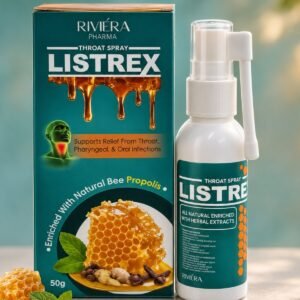
For a sore, scratchy throat, LISTREX Throat Spray is a supportive spray that brings together bee propolis, which supports the throat's natural defences, and honey, which coats it. Clove oil helps ease throat pain, and peppermint, eucalyptus and wild thyme help ease the congestion and swelling that come with an inflamed throat, with green tea extract and lemon peel oil for fresh breath. Its long nozzle reaches the back of the throat. It is supportive care alongside fluids and rest, not a treatment, and it does not replace a doctor when the warning signs above appear. Ask your pharmacist whether it suits you.
Meet the ingredients
ProfessionalA scientific summary for pharmacists and physicians; references are published and verified on PubMed.
Definition and causes
Acute sore throat (pharyngitis or tonsillopharyngitis) is pain on swallowing with inflammation of the pharynx. Respiratory viruses (rhinovirus, coronavirus, adenovirus, influenza, parainfluenza, Epstein–Barr virus) cause most cases; group A streptococcus causes about 5–15% in adults and 20–30% in children (Wessels 2011). Non-infective causes include dry air, voice strain, smoking and laryngopharyngeal reflux.
Natural course
Symptoms resolve within one week in about 85% of people regardless of cause (Kenealy 2014). In the Cochrane review, antibiotics reduced symptoms at day three and shortened illness by about 16 hours overall, with a small absolute reduction in suppurative complications (Spinks 2021).
Assessment
Clinical scores (Centor, McIsaac, FeverPAIN) estimate the probability of streptococcal infection and guide testing and antibiotic use (Wessels 2011). Red flags requiring urgent referral: stridor or respiratory distress, drooling, inability to swallow, trismus, unilateral severe pain with uvular deviation suggesting peritonsillar abscess (Klug 2017), and signs of systemic illness.
Symptomatic care
Analgesics (paracetamol, ibuprofen), fluids and rest are first line. Topical products (sprays, lozenges) provide short-term local comfort. Evidence for supportive ingredients: a standardised propolis oral spray led to earlier symptom remission than placebo in 122 adults with mild upper respiratory tract infection (Esposito 2021); honey improved combined symptoms and cough versus usual care in a meta-analysis of 14 studies (Abuelgasim 2021); menthol provides a cooling sensation through TRPM8 (Eccles 1994). These products do not replace assessment or antibiotics when indicated.
Safety
Propolis is a recognised contact allergen (de Groot 2013); ask about bee-product and essential-oil allergy, asthma, pregnancy and the age of the patient.
References
- 1Kenealy T. Sore throat. BMJ Clin Evid. 2014;2014. PMID 24589314
- 2Spinks A, Glasziou PP, Del Mar CB. Antibiotics for treatment of sore throat in children and adults. Cochrane Database Syst Rev. 2021;12(12):CD000023. PMID 34881426 DOI
- 3Wessels MR. Clinical practice. Streptococcal pharyngitis. N Engl J Med. 2011;364(7):648–655. PMID 21323542 DOI
- 4Klug TE. Peritonsillar abscess: clinical aspects of microbiology, risk factors, and the association with parapharyngeal abscess. Dan Med J. 2017;64(3). PMID 28260599
- 5Esposito C, Garzarella EU, Bocchino B, et al. A standardized polyphenol mixture extracted from poplar-type propolis for remission of symptoms of uncomplicated upper respiratory tract infection (URTI): a monocentric, randomized, double-blind, placebo-controlled clinical trial. Phytomedicine. 2021;80:153368. PMID 33091857 DOI
- 6Abuelgasim H, Albury C, Lee J. Effectiveness of honey for symptomatic relief in upper respiratory tract infections: a systematic review and meta-analysis. BMJ Evid Based Med. 2021;26(2):57–64. PMID 32817011 DOI
- 7Eccles R. Menthol and related cooling compounds. J Pharm Pharmacol. 1994;46(8):618–630. PMID 7529306 DOI
- 8de Groot AC. Propolis: a review of properties, applications, chemical composition, contact allergy, and other adverse effects. Dermatitis. 2013;24(6):263–282. PMID 24201459 DOI
Found it useful? Share it with someone who cares
This article is general information and is not a substitute for advice from a doctor or pharmacist.