
RIVIERA PRO HYGIENE · For healthcare professionals
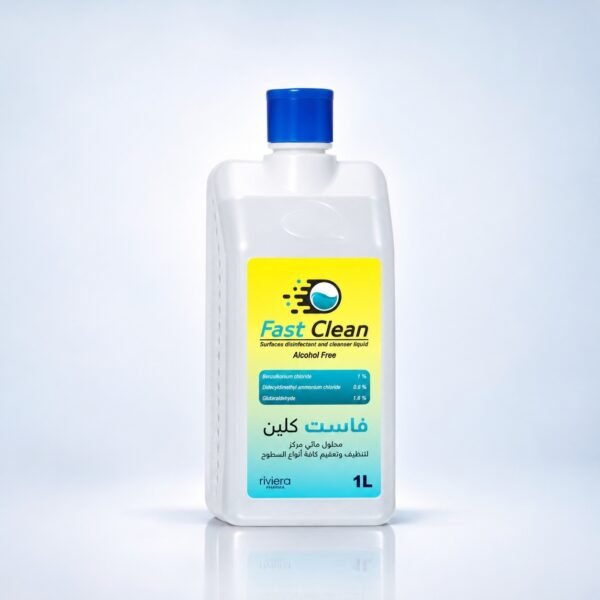
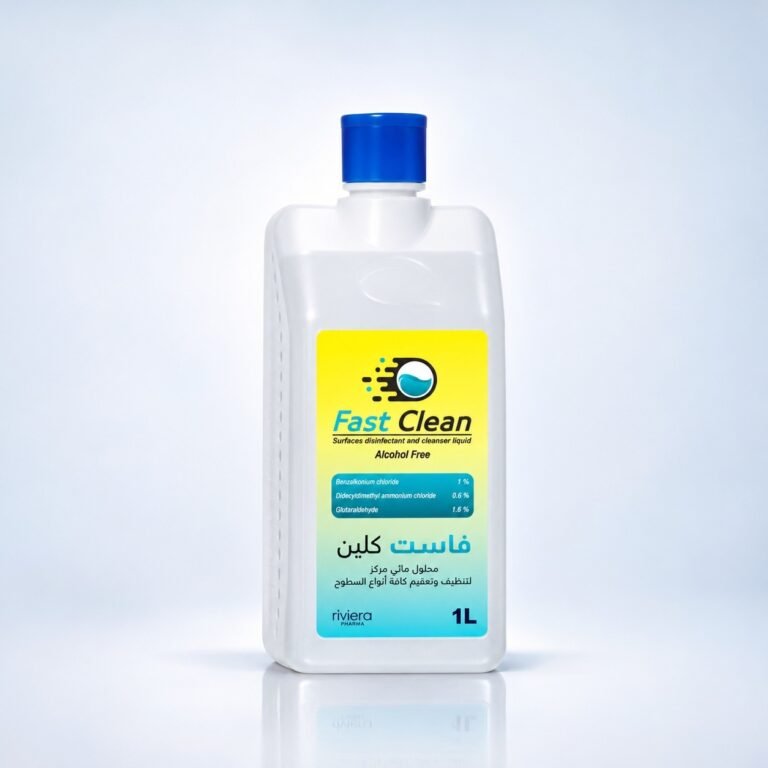
FAST CLEAN
High-Level Disinfectant for Endoscopes & Instruments, and for High-Risk Surfaces
- Ready to use for endoscopes & instruments · concentrate for surfaces
- Flexible and rigid endoscopes
- Heat-sensitive surgical instruments
- Before the autoclave for heat-stable instruments
WhereFlexible and rigid endoscopes
HowImmerse
Time20 minutes
4StepAfter enzymatic cleaning: high-level disinfection for endoscopes, and before the autoclave for instruments
Size: 1 L · Bottle
SKU RV-PH-FASTCLEAN-1L
This size has no listed price yet: send an order request and management will contact you with the price and delivery time.
About this product
FAST CLEAN is an alcohol-free solution combining glutaraldehyde 1.6% with two quaternary compounds, benzalkonium chloride 1% and DDAC 0.6%. Glutaraldehyde acts by cross-linking microbial proteins; the quats help wetting and complete the activity.
For endoscopes and heat-sensitive surgical instruments it is used undiluted: full immersion for 20 minutes at 20 °C or above after enzymatic cleaning, then a sterile-water rinse. Its glutaraldehyde level is above the minimum effective concentration (1–1.5%), and it does not damage lenses, rubber or plastics.
For operating and isolation room surfaces dilute to 2.5% and wipe, without spraying, with the room ventilated until the odour is gone. Instruments that tolerate heat complete their cycle in the autoclave.
- Form
- Ready to use for endoscopes & instruments · concentrate for surfaces
- Contact time
- 20 minutesUndiluted immersion for endoscopes and instruments at 20 °C or above · surfaces: 2.5% dilution
- Step in the cycle
- After enzymatic cleaning: high-level disinfection for endoscopes, and before the autoclave for instruments
- Packs
- 500 mL · 1 L
Default sterilization order
Where it fits in the patient cycle
- 0Wash hands if visibly soiledRIVIERA WASH
- 1Hand antisepsis before the patient and after glove removalSEPTA RAPID
- 2Clinical-contact surfaces between patientsBROADFECT · SEPTA-S
- 3Enzymatic instrument cleaningINSTRUVIRA PLUS
- 4High-level disinfection of endoscopes & instrumentsFAST CLEANYou are here
- 5Rinse · dry · inspect
- 6Pack, then autoclaveFinal sterilization
Where to use it
- Flexible and rigid endoscopes
- Heat-sensitive surgical instruments
- Before the autoclave for heat-stable instruments
- Operating and isolation room surfaces
- Floors and walls in high-risk areas
Do not use for:
Hands or skinSpraying onto surfaces (glutaraldehyde mist)As a substitute for the autoclave for heat-stable instruments
Benefits
- Safe on endoscope lensesGlutaraldehyde does not damage lensed instruments, rubber or plastics (CDC 2008).
- 20 minutesHigh-level disinfection by undiluted immersion at 20 °C or above.
- Endoscopes and instrumentsHeat-sensitive ones, and before the autoclave for heat-stable ones.
- High-risk surfacesOperating and isolation rooms at 2.5%, with ventilation.
Antimicrobial spectrum and contact time
Organisms are ordered from easiest to hardest to kill. The more resistant the organism, the longer the contact time or the stronger the agent it needs; bacterial spores are the most resistant.
- Enveloped virusesInfluenza, coronaviruses, HBV, HCV, HIVActive20 minReferenceUnder 10 min · 2% glutaraldehyde (CDC 2008)
- BacteriaIncluding MRSA and VREActive20 minReferenceUnder 2 min · 2% glutaraldehyde (CDC 2008)
- Yeasts & fungiCandidaActive20 minReferenceUnder 10 min · 2% glutaraldehyde (CDC 2008)
- Non-enveloped virusesRota, adeno, noroActive, longer time or conditions20 minReferenceUnder 10 min · 2% glutaraldehyde (CDC 2008)
- MycobacteriaTB bacilliActive, longer time or conditions20 minReference20 min at 20 °C · minimum effective 1–1.5% (CDC 2008)
- Bacterial sporesThe most resistantLimited or variable Reference3 h in vitro, 10 h for sterilization (CDC 2008)
Times are for the undiluted solution at 20 °C or above. The 2.5% surface dilution works mainly through the quats and is relied on for bacteria, enveloped viruses and yeasts. Spores need hours of contact, so it is not a sterilant for critical instruments. The high-level disinfection claim is confirmed by a product test report to European standards (EN 14348 for mycobacteria, EN 14476 for viruses).
The time next to the clock is the product’s contact time and appears only where the literature for the active class supports it. Under each group: the time or condition the reference reports. Activity not established needs a product test report to European (EN) standards.
- Rutala WA, Weber DJ, HICPAC. Guideline for Disinfection and Sterilization in Healthcare Facilities, 2008 (updated 2019). CDC.
- Russell AD. Glutaraldehyde: current status and uses. Infect Control Hosp Epidemiol. 1994;15(11):724–733. PMID 7852730
- McDonnell G, Russell AD. Antiseptics and disinfectants: activity, action, and resistance. Clin Microbiol Rev. 1999;12(1):147–179. PMID 9880479
- Gerba CP. Quaternary ammonium biocides: efficacy in application. Appl Environ Microbiol. 2015;81(2):464–469. PMID 25362069
What’s inside, simply explained
Select an ingredient to see what it is and why it is used. The simple explanation is for nurses and assistants, the scientific one for doctors and specialists.
Glutaraldehyde 1.6%
In simple words
A strong aldehyde for surfaces and instruments.
Its role here
Main active
The science, for doctors and specialists
A dialdehyde that cross-links amino groups of proteins and nucleic acids; the minimum effective concentration for high-level disinfection is 1–1.5% (Rutala 2008).
Benzalkonium chloride 1%
In simple words
A gentle disinfectant that lowers germs and helps cleaning.
Its role here
Supporting activity and wetting
The science, for doctors and specialists
A cationic quaternary ammonium compound that disorganises the cytoplasmic membrane; active on bacteria and enveloped viruses, weak on mycobacteria and non-enveloped viruses, not sporicidal.
DDAC 0.6%
In simple words
A strong alcohol-free quat for surfaces.
Its role here
Supporting activity
The science, for doctors and specialists
A newer-generation twin-chain quaternary ammonium compound (DDAC); more tolerant of hard water and organic load than benzalkonium chloride.
Ingredient library: Didecyldimethylammonium Chloride (DDAC) ›
How to use
Endoscopes and instruments: undiluted
- 1Wear nitrile gloves, goggles and an apron, and work under extraction or in a well-ventilated room.
- 2After the leak test, clean the endoscope and instruments with INSTRUVIRA, brush the channels, then rinse.
- 3Pour FAST CLEAN undiluted into a covered tray, immerse the instruments and endoscope fully and fill every channel with solution.
- 4Leave for at least 20 minutes at 20 °C or above with the tray covered.
- 5Rinse with sterile or filtered water and flush the channels, then flush with 70% alcohol and air-dry.
- 6Hang the endoscope dry in a clean cabinet; pack heat-stable instruments and sterilize them in the autoclave.
High-risk surfaces: 2.5% dilution
- 1Turn on ventilation or open the windows before you start, with no patients in the room.
- 2Prepare a 2.5% dilution: 25 mL per 1 L of water.
- 3Wipe beds, tables, walls and floors with a wet cloth, without spraying, and keep the surface wet for 30 minutes.
- 4Let it dry with ventilation running until the odour is gone, then wipe patient-contact surfaces with a cloth dampened with water.
Required contact time
20 minutes
Undiluted immersion for endoscopes and instruments at 20 °C or above · surfaces: 2.5% dilution
Dilution calculator
Bath / container volume
FAST CLEAN—mL
Water—mL
- Irritant vapour (glutaraldehyde)
Use in a well-ventilated area in a covered container, with nitrile gloves and eye protection. Avoid breathing the vapour and skin contact.
Safe-use informationLimits of use before you start
Glutaraldehyde vapour is irritating and can cause skin and respiratory sensitisation: use it in a well-ventilated area or under extraction, in covered trays, with nitrile gloves and goggles. The occupational exposure limit (ACGIH) is a 0.05 ppm ceiling. It does not replace the autoclave for instruments that tolerate heat.
Keep out of reach of children, in the original closed container. Read the label and the safety data sheet before use.
Technical documents
From the Riviera science journal
Read about disinfection
Infection controlGlutaraldehyde vs formaldehyde: two aldehydes, not oneThey share a family name and a sharp smell, but they differ in structure, strength, use and safety. Why “formaldehyde-free” does not mean “aldehyde-free”.6 min read · 5 referencesInfection controlFrom chair to autoclave: the order of instrument reprocessingCleaning comes before everything else, and heat sterilization stays the standard for instruments that tolerate it. A step-by-step look at the sterilization cycle.6 min read · 3 referencesInfection controlWorking safely with disinfectants: dilution, contact time and ventilationThe right dilution, the full contact time and the right protection make disinfectants work and keep staff safe. What to check before you start.5 min read · 3 references
Instruments & endoscopes
More for the same area
INSTRUVIRA PLUS
Concentrated Enzymatic Cleaner for Endoscopes & Medical Instruments
Price on requestAdd to order
