Everyday hygiene5 min read · 8 references
Rinse-free foam: what it does when there is no sink
Alcohol-free sanitising foams are applied to dry hands and left to dry. What the studies show they do, where they fall short, and how to use them well.
Not every moment has a sink. At a restaurant table, on a road trip, at a picnic or in a waiting room, the choice is often between a rinse-free sanitiser and doing nothing. A sanitising foam fills that gap: it is applied to dry hands, rubbed in and left to dry, with no water and no towel.
What a rinse-free foam is
A rinse-free foam is a leave-on product. It is not soap: it does not need water, it is not rinsed off, and it does not lift heavy dirt away. Alcohol-free foams usually rely on benzalkonium chloride, a quaternary ammonium compound, at about 0.1%. The pump turns the liquid into foam, so it stays where it is applied and spreads evenly over the hands.
What the studies show
- Bacteria on the hands. A benzalkonium chloride sanitiser (0.12%) reduced Staphylococcus aureus on the skin and kept working for up to 4 hours after application, longer than an ethanol comparator (Bondurant 2019). In healthcare workers, the same type of product lowered transient S. aureus on the fingertips (Bondurant 2020).
- Enveloped viruses. Quaternary ammonium products, including an alcohol-free hand sanitiser, inactivated SARS-CoV-2 within 15 seconds in laboratory tests (Ogilvie 2021).
- Everyday life. In elementary schools, children who used an alcohol-free sanitiser in addition to normal hand washing had fewer illness-related absences (Dyer 2000; White 2001).
Where it has limits
- Norovirus. On human fingerpads, a 0.1% benzalkonium chloride sanitiser reduced norovirus much less than alcohol products (Escudero-Abarca 2022).
- Clinical hand hygiene. In one hospital ward study, a benzalkonium chloride foam showed no detectable reduction of bacteria on healthcare workers' fingertips, while the alcohol rub did (Lehtinen 2022). In clinics, the alcohol hand rub stays the standard.
- Visibly dirty or greasy hands. When hands are visibly soiled, washing with soap and water comes first (WHO 2009).
How to use it well
1. Wipe off food or visible dirt first.
2. Apply one pump of foam to dry hands.
3. Rub all surfaces of the hands, including fingertips and thumbs, for about 60 seconds.
4. Let the hands dry. Do not rinse or towel off.
5. For tables, apply the foam to the surface or to a cloth, wipe and let dry.
Where FOAMY fits
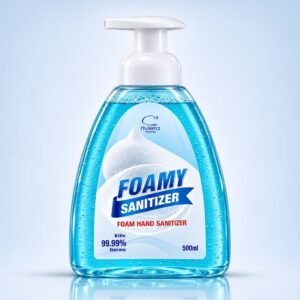
FOAMY is an alcohol-free, rinse-free foam with benzalkonium chloride 0.1%. It suits restaurant and café tables, trips and travel, and reception areas. It does not replace soap and water for dirty hands, or an alcohol hand rub at clinical moments.
Riviera Pharma
How Riviera can help
Meet the ingredients
ProfessionalA scientific summary for pharmacists and physicians; references are published and verified on PubMed.
Benzalkonium chloride (0.1–0.12%) leave-on sanitisers show persistent activity against S. aureus on skin (Bondurant 2019, 2020) and rapid inactivation of enveloped viruses such as SARS-CoV-2 (Ogilvie 2021), with community benefit in school trials (Dyer 2000; White 2001). Activity is weak against norovirus (Escudero-Abarca 2022), and a ward study found no detectable fingertip reduction compared with alcohol rub (Lehtinen 2022). Alcohol-based rub remains the clinical standard (WHO 2009).
References
- 1Bondurant SW, Duley CM, Harbell JW. Demonstrating the persistent antibacterial efficacy of a hand sanitizer containing benzalkonium chloride on human skin at 1, 2, and 4 hours after application. Am J Infect Control. 2019;47(8):928-932. PMID 30777389
- 2Bondurant S, McKinney T, Bondurant L, Fitzpatrick L. Evaluation of a benzalkonium chloride hand sanitizer in reducing transient Staphylococcus aureus bacterial skin contamination in health care workers. Am J Infect Control. 2020;48(5):522-526. PMID 31668935
- 3Ogilvie BH, Solis-Leal A, Lopez JB, et al. Alcohol-free hand sanitizer and other quaternary ammonium disinfectants quickly and effectively inactivate SARS-CoV-2. J Hosp Infect. 2021;108:142-145. PMID 33259880
- 4Dyer DL, Shinder A, Shinder F. Alcohol-free instant hand sanitizer reduces elementary school illness absenteeism. Fam Med. 2000;32(9):633-638. PMID 11039151
- 5White CG, Shinder FS, Shinder AL, Dyer DL. Reduction of illness absenteeism in elementary schools using an alcohol-free instant hand sanitizer. J Sch Nurs. 2001;17(5):258-265. PMID 11885342
- 6Escudero-Abarca BI, Goulter RM, Manuel CS, et al. Comparative assessment of the efficacy of commercial hand sanitizers against human norovirus evaluated by an in vivo fingerpad method. Front Microbiol. 2022;13:869087. PMID 35464915
- 7Lehtinen JM, Kanerva M, Tarkka E, Ollgren J, Anttila VJ. Low efficacy of three non-alcohol-based hand disinfectants utilizing silver polymer, lactic acid and benzalkonium chloride on inactivation of bacteria on the fingertips of healthcare workers. J Hosp Infect. 2022;125:55-59. PMID 35398451
- 8World Health Organization. WHO Guidelines on Hand Hygiene in Health Care. Geneva: WHO; 2009.
Found it useful? Share it with someone who cares
Reviewed by: Riviera Pharma Scientific Affairs Team. General information; it does not replace the product label.