Eyes & contact lenses5 min read · 7 references
Red, itchy eyes with lenses? How poor lens cleaning leads to eye infections
Conjunctivitis and corneal infections in lens wearers usually start with small daily habits. Here is what causes them and how a simple night-time routine protects your eyes.
Did you know?
Sleeping in lenses raises the risk of a serious corneal infection about five times.
Tap water can carry germs that cause rare but severe eye infections.
A dirty lens case is one of the clearest risk factors for lens-related eye infection.
Rubbing and rinsing before soaking removes more germs than soaking alone.
Contact lenses are safe when they are cared for well. Most eye infections in lens wearers start from small habits: rinsing with water, reusing old solution, or sleeping in lenses.
What are conjunctivitis and keratitis?
- Conjunctivitis is irritation of the thin layer that covers the white of the eye and the inside of the eyelids. The eye becomes red, itchy and sticky. In lens wearers, deposits on old or poorly cleaned lenses can cause a type called papillary conjunctivitis.
- Keratitis is infection or inflammation of the cornea, the clear window at the front of the eye. It is less common but more serious, and needs treatment quickly.
How does poor cleaning cause infection?
Germs are everywhere: on our hands, in tap water and in the air of the bathroom. A lens that is not cleaned well collects them, and the lens then holds them against your eye for hours.
The most common mistakes:
- Rinsing lenses or the case with tap water.
- Adding new solution on top of old solution in the case.
- Not rubbing the lens before soaking it.
- Sleeping, showering or swimming in lenses.
- Using the same case for many months.
- Touching lenses without washing your hands.
Studies show that sleeping in lenses raises the risk of a serious corneal infection about five times, and a dirty lens case is one of the clearest risk factors.
MythIf my eyes are not red, my lenses are clean.
FactGerms and deposits build up before you feel anything. Clean your lenses every time you take them out.
MythKeeping lenses in the same solution for a few days is fine.
FactOld solution loses its power. Use fresh solution every night.
The deep clean that happens while you sleep
Your lenses need a real rest every night, not just a quick rinse.

- Rub: a few drops and 10 to 15 seconds of gentle rubbing loosen deposits.
- Rinse: with the solution only, never with water.
- Soak overnight: at least 6 hours in fresh solution, so the disinfectant has time to work.
- Care for the case: rinse it with the solution, let it dry face down, and change it every 3 months.

Signs you must not ignore
Remove your lenses and see an eye doctor the same day if you have:
- Eye pain or a feeling that something is stuck in the eye.
- Redness that does not go away.
- Blurred vision.
- Sensitivity to light.
- A white spot on the coloured part of the eye.
Do not put the lenses back in until the doctor allows it, and take your lenses and case with you to the appointment.
Riviera Pharma
How Riviera can help
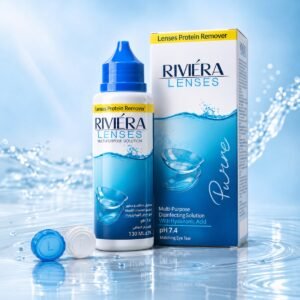
RIVIERA Lenses is made for this night-time routine. PHMB (0.0001%) disinfects your lenses while they soak overnight, poloxamer 407 helps lift deposits and protein when you rub, and hyaluronic acid (0.01%) keeps them moist for the next day. Its liquid is balanced like your natural tears, and every pack comes with a new lens case, so changing your case is easy.
Meet the ingredients
ProfessionalA scientific summary for pharmacists and physicians; references are published and verified on PubMed.
Spectrum
Lens-related inflammation ranges from contact lens papillary (giant papillary) conjunctivitis, linked to deposits, infrequent replacement, long wearing time and poor hygiene (Kenny 2020), to microbial keratitis, the most serious complication (Alipour 2017).
Epidemiology and risk factors
Annualised microbial keratitis incidence is about 1.9 per 10,000 daily soft lens wearers and 19.5 per 10,000 with overnight soft lens wear; risk factors include overnight wear, poor storage case hygiene, smoking and less than 6 months' experience (Stapleton 2008). Overnight wear raises risk about 5.4-fold for any lens type (Dart 2008). Showering in lenses (OR 3.1) and sleeping in lenses (OR 3.1) are key personal hygiene risks (Stellwagen 2020). Water exposure, solution topping-off and case hygiene contributed to the UK Acanthamoeba outbreak (Carnt 2018).
Prevention through lens care
Rub-and-rinse before soaking gives the greatest MPS efficacy against bacteria, fungi and Acanthamoeba (Zhu 2011). Advise fresh solution nightly, minimum 6 h soak, no water contact, case rinsing with solution, air-drying face down and replacement every 3 months. RIVIERA Lenses (PHMB 0.0001%, sodium hyaluronate 0.01%, poloxamer 407, borate buffer) supports this routine.
Referral
Pain, photophobia, reduced vision or a corneal infiltrate in a lens wearer require same-day ophthalmic assessment; lenses and case should be brought for culture.
References
- 1Stapleton F, Keay L, Edwards K, et al. The incidence of contact lens-related microbial keratitis in Australia. Ophthalmology. 2008;115(10):1655-62. PMID 18538404 DOI
- 2Dart JK, Radford CF, Minassian D, et al. Risk factors for microbial keratitis with contemporary contact lenses: a case-control study. Ophthalmology. 2008;115(10):1647-54. PMID 18597850 DOI
- 3Stellwagen A, MacGregor C, Kung R, et al. Personal hygiene risk factors for contact lens-related microbial keratitis. BMJ Open Ophthalmol. 2020;5(1):e000476. PMID 32953996 DOI
- 4Carnt N, Hoffman JJ, Verma S, et al. Acanthamoeba keratitis: confirmation of the UK outbreak and a prospective case-control study identifying contributing risk factors. Br J Ophthalmol. 2018;102(12):1621-1628. PMID 30232172 DOI
- 5Kenny SE, Tye CB, Johnson DA, et al. Giant papillary conjunctivitis: a review. Ocul Surf. 2020;18(3):396-402. PMID 32339665 DOI
- 6Alipour F, Khaheshi S, Soleimanzadeh M, et al. Contact lens-related complications: a review. J Ophthalmic Vis Res. 2017;12(2):193-204. PMID 28540012 DOI
- 7Zhu H, Bandara MB, Vijay AK, et al. Importance of rub and rinse in use of multipurpose contact lens solution. Optom Vis Sci. 2011;88(8):967-72. PMID 21623253 DOI
Found it useful? Share it with someone who cares
This article is for general information and does not replace the advice of your eye doctor. A red, painful eye in a lens wearer needs medical care the same day.