
Hair & scalp5 min read · 8 references
Head lice: a calm, step-by-step plan to clear them
Why lice spread, what they are not about, and how to treat them properly so they do not come back.
Did you know?
Lice crawl from head to head; they cannot jump or fly.
Head lice are not a sign of poor hygiene.
Eggs hatch in about a week, so a second treatment after 7 to 10 days matters.
In many regions lice have become resistant to some insecticides.
Finding lice in your child's hair can feel alarming, but head lice are very common, especially among school children, and they can be cleared with the right routine. They do not spread disease, and they are not a sign that anyone is dirty.
What are head lice?
Head lice are tiny wingless insects, about the size of a sesame seed, that live only on the human scalp and feed on small amounts of blood. Females glue their eggs (nits) to the hair shaft close to the scalp. The eggs hatch in about a week, and young lice become adults that lay eggs within another week or so.
How do they spread?
Lice crawl; they cannot jump or fly. They pass mainly through direct head-to-head contact, during play, sleepovers or selfies. Sharing hats, combs or pillows plays a much smaller role.
MythLice mean poor hygiene.
FactLice are just as happy on clean hair as on dirty hair.
MythPets can give you head lice.
FactHead lice live only on humans.
MythKerosene, insect sprays or shaving the head are needed.
FactThese are unnecessary, and kerosene and garden insecticides are dangerous.
How do you know it is lice?
Itching, especially behind the ears and at the nape, is the classic sign, but some people do not itch at all. The surest check is wet combing: wash and condition the hair, then comb section by section with a fine-toothed lice comb, wiping it on white paper. Seeing a live louse confirms an active infestation. Empty nit shells far from the scalp often mean an old, treated infestation.
What helps
- Use a proven lice treatment and follow the leave-on time exactly.
- Choose your approach: physically acting treatments such as dimeticone coat and immobilise lice and are not affected by resistance; insecticides such as permethrin act on the lice nerves.
- Comb out dead lice and nits with a fine-toothed comb after treatment.
- Repeat once after 7 to 10 days to catch lice that hatch from eggs that survived.
- Check everyone at home and treat only those with live lice, all on the same day.
- Wash recently used pillowcases, hats and brushes in hot water. There is no need to fumigate the house.
When to see a doctor
See a doctor or pharmacist if live lice remain after two correct treatments, if the scalp is broken, oozing or infected, if your child is younger than 2 years, or if you are pregnant or breastfeeding and need to treat.
Riviera Pharma
How Riviera can help
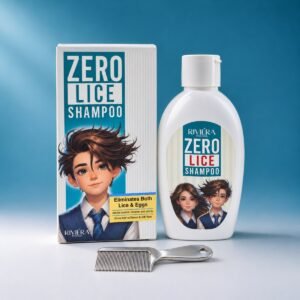
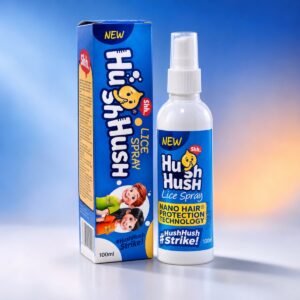
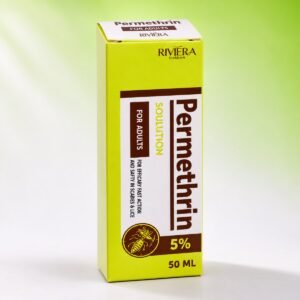
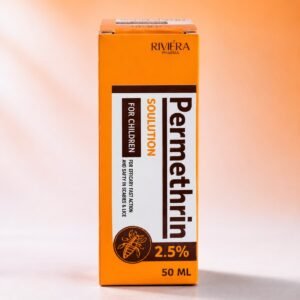
Riviera offers two ways to treat head lice. ZERO LICE shampoo is pesticide-free: its dimeticone coats lice and nits in a fine film, and a fine-toothed comb comes in the box. HUSH HUSH lice spray contains permethrin 2.5%; it is left on for 30 minutes, then washed out with HUSH HUSH shampoo, which contains permethrin 1% and can also be used on its own. Riviera Permethrin solutions, 5% for adults and 2.5% for children, help treat both head lice and scabies. If lice survive two correct treatments with permethrin, ZERO LICE gives a different, physical mode of action.

Meet the ingredients
ProfessionalA scientific summary for pharmacists and physicians; references are published and verified on PubMed.
Definition and epidemiology
Pediculosis capitis is infestation of the scalp hair by Pediculus humanus capitis, an obligate human ectoparasite. It is most common in children aged 3 to 11 years and their households, independent of hygiene or socioeconomic status, and is not a vector of disease (Nolt 2022).
Life cycle and transmission
Eggs are cemented to the hair shaft within a few millimetres of the scalp and hatch after about 7 to 10 days; nymphs mature in about 9 to 12 days. Transmission is predominantly by direct head-to-head contact; fomites play a minor role.
Diagnosis
The gold standard is detection of a live louse; wet combing with a fine-toothed comb is more sensitive than visual inspection. Nits more than 1 cm from the scalp are usually non-viable and do not on their own justify treatment (Nolt 2022).
Management
Physically acting agents (dimeticone) block the louse spiracles and water excretion and are unaffected by insecticide resistance (Burgess 2009); 4% dimeticone lotion was equivalent to phenothrin with fewer irritant reactions (Burgess 2005), and high-concentration dimeticone was superior to 1% permethrin (Heukelbach 2008). Neurotoxic pediculicides (permethrin, pyrethrins) remain widely used, but knockdown-resistance (kdr) mutations of the voltage-gated sodium channel are common in many regions and reduce efficacy (Durand 2012). Because most agents are not fully ovicidal, a second application at 7 to 10 days is standard. Adjunctive wet combing improves outcomes.
Treatment failure
Persistent live lice after two correctly applied treatments suggest resistance, incorrect application or reinfestation: switch mechanism (for example from a pyrethroid to dimeticone) and examine contacts.
Special populations
Infants under 2 months, pregnancy and lactation: prefer physical removal and agents with minimal absorption; use pyrethroids on medical advice (Nolt 2022).
References
- 1Nolt D, Moore S, Yan AC, Melnick L. Head Lice. Pediatrics. 2022;150(4):e2022059282. doi:10.1542/peds.2022-059282 PMID 36156158 DOI
- 2Burgess IF. The mode of action of dimeticone 4% lotion against head lice, Pediculus capitis. BMC Pharmacol. 2009;9:3. doi:10.1186/1471-2210-9-3 PMID 19232080 DOI
- 3Burgess IF, Brown CM, Lee PN. Treatment of head louse infestation with 4% dimeticone lotion: randomised controlled equivalence trial. BMJ. 2005;330(7505):1423. doi:10.1136/bmj.38497.506481.8F PMID 15951310 DOI
- 4Heukelbach J, Pilger D, Oliveira FA, et al. A highly efficacious pediculicide based on dimeticone: randomized observer blinded comparative trial. BMC Infect Dis. 2008;8:115. doi:10.1186/1471-2334-8-115 PMID 18783606 DOI
- 5Durand R, Bouvresse S, Berdjane Z, et al. Insecticide resistance in head lice: clinical, parasitological and genetic aspects. Clin Microbiol Infect. 2012;18(4):338-44. doi:10.1111/j.1469-0691.2012.03806.x PMID 22429458 DOI
- 6Meinking TL, Clineschmidt CM, Chen C, et al. An observer-blinded study of 1% permethrin creme rinse with and without adjunctive combing in patients with head lice. J Pediatr. 2002;141(5):665-70. doi:10.1067/mpd.2002.129031 PMID 12410195 DOI
- 7Koch E, Clark JM, Cohen B, et al. Management of Head Louse Infestations in the United States: A Literature Review. Pediatr Dermatol. 2016;33(5):466-72. doi:10.1111/pde.12982 PMID 27595869 DOI
- 8Gunning K, Kiraly B, Pippitt K. Lice and Scabies: Treatment Update. Am Fam Physician. 2019;99(10):635-642. PMID 31083883
Found it useful? Share it with someone who cares
This article is general information and is not a substitute for advice from a doctor or pharmacist.