Feminine care6 min read · 8 references
Intimate care at every age: from the first period onward
What changes from puberty to menopause, how a teenage girl can care for herself with confidence, and how to choose the right wash.
Did you know?
Wash the outside only; the vagina cleans itself inside.
A clear or white discharge before the first period is normal.
During the period, change the pad every 4–6 hours.
Douching is not recommended at any age.
A wash keeps the area fresh; it does not treat an infection.
From the first period to motherhood and beyond, the intimate area changes with every stage of a woman's life. Each stage needs the same simple thing: gentle, regular care that protects the skin's natural balance instead of fighting it.
This guide covers what changes, how to care for the area at each age, and how to choose the right wash.
Why gentle care matters
The skin of the external intimate area is thinner and more sensitive than skin elsewhere, and it reacts more easily to harsh soaps and perfumes. The area also has its own good bacteria that keep it healthy.
Good care means:
- washing the outside only, never inside the vagina
- using a mild, soap-free wash made for this area
- rinsing well and drying gently
Puberty: the first years
Puberty brings big changes. Hormones start to work, and a clear or white discharge appears months before the first period. This is normal and a sign that the body is maturing.
What helps a teenage girl most is simple knowledge and a calm routine:
- Wash once a day with water and a gentle intimate wash, from front to back
- During the period, change the pad every 4–6 hours, and wash a little more often
- Wear cotton underwear and change it every day
- Avoid scented sprays, wipes and douches; the area cleans itself inside
Studies show that girls who learn about their period early feel more confident and look after themselves better. A mother, an older sister or a school nurse can make all the difference.
Choosing a wash for a teenager
A teenage girl needs the gentlest option, every day:
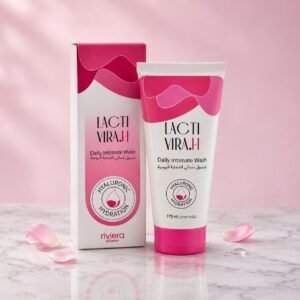
- LACTI VIRA.H is a soap-free daily wash with lactic acid, hyaluronic acid, jojoba oil and shea butter. It cleans gently and keeps the area fresh and comfortable, from the first period on.
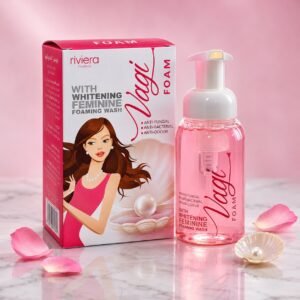
- VAGI Foam is a daily antiseptic foam with hexamidine, tea tree oil and chamomile, with vitamin C. It helps against germs and odour, which can be useful on hot days and during the period.

A bonus for teenage skin: acne
Acne often appears at the same age. The antiseptic ingredients in VAGI Foam can also help keep spots on the face and back in check: tea tree oil has been tested in acne studies, and hexamidine is used in acne care. Lather on wet skin, rinse well and keep it away from the eyes.
The adult years
Daily care stays simple: one gentle wash a day. Some times need a little more:
- during the period
- after childbirth
- in hot weather or after sport
VAGI Foam suits daily use. RIVITIAL Foam, a stronger antiseptic foam, is meant for these times of higher need only, not for every day.
After menopause
With less estrogen, the skin becomes thinner and drier. Choose a mild, soap-free wash such as LACTI VIRA.H, rinse well and avoid perfumed products. If dryness or discomfort continues, talk to your doctor.
When to see a doctor
At any age, a visit is needed if you notice:
- discharge with an unusual colour or a strong smell
- itching, burning or pain that does not settle within a few days
- sores, swelling or bleeding between periods
- for girls: no period by age 15, or periods that are very painful or very heavy
A wash keeps the area clean and fresh; it does not treat an infection.
Riviera Pharma
How Riviera can help
LACTI VIRA.H is a gentle, soap-free daily wash that suits girls from their first period, and women at every age after. VAGI Foam is a daily antiseptic foam that helps against germs and odour, and can also help keep acne spots in check. Both are for external use only.
Meet the ingredients
ProfessionalA scientific summary for pharmacists and physicians; references are published and verified on PubMed.
Physiology across the lifespan
Vulvar skin and vaginal mucosa change with hormonal status: estrogen at puberty thickens the epithelium and establishes a lactobacillus-dominated microbiota with physiological leukorrhoea; after menopause the epithelium thins and becomes drier (Farage 2006; Farage 2011). Vulvar skin is more permeable and more reactive to irritants than exposed skin (Farage 2005).
Hygiene practices
External washing with mild products is widespread and compatible with vulvovaginal health, whereas douching is associated with adverse outcomes and is not recommended (Chen 2017).
Adolescents and menstrual health
Inadequate knowledge and facilities are linked to poor menstrual hygiene practices (Kaur 2018); education interventions improve knowledge and practices of young adolescent girls (Evans 2022). Practical advice: daily external washing front to back, regular pad changes, cotton underwear, no douching or scented products.
Antiseptics and acne-prone skin
Tea tree oil gel reduced acne lesions versus placebo (Enshaieh 2007), and a hexamidine-containing formulation performed like adapalene in mild-to-moderate acne (Lee 2011). An antiseptic wash is adjunct care only.
References
- 1Farage M, Maibach H. Lifetime changes in the vulva and vagina. Arch Gynecol Obstet. 2006;273(4):195-202. PMID 16208476 DOI
- 2Farage MA, Maibach HI. Morphology and physiological changes of genital skin and mucosa. Curr Probl Dermatol. 2011;40:9-19. PMID 21325836 DOI
- 3Farage MA. Vulvar susceptibility to contact irritants and allergens: a review. Arch Gynecol Obstet. 2005;272(2):167-72. PMID 15906051 DOI
- 4Chen Y, Bruning E, Rubino J, Eder SE. Role of female intimate hygiene in vulvovaginal health: global hygiene practices and product usage. Womens Health (Lond). 2017;13(3):58-67. PMID 28934912 DOI
- 5Kaur R, Kaur K, Kaur R. Menstrual hygiene, management, and waste disposal: practices and challenges faced by girls/women of developing countries. J Environ Public Health. 2018;2018:1730964. PMID 29675047 DOI
- 6Evans RL, Harris B, Onuegbu C, Griffiths F. Systematic review of educational interventions to improve the menstrual health of young adolescent girls. BMJ Open. 2022;12(6):e057204. PMID 35676001 DOI
- 7Enshaieh S, Jooya A, Siadat AH, Iraji F. The efficacy of 5% topical tea tree oil gel in mild to moderate acne vulgaris: a randomized, double-blind placebo-controlled study. Indian J Dermatol Venereol Leprol. 2007;73(1):22-5. PMID 17314442 DOI
- 8Lee HE, Ko JY, Kim YH, et al. A double-blind randomized controlled comparison of APDDR-0901, a novel cosmeceutical formulation, and 0.1% adapalene gel in the treatment of mild-to-moderate acne vulgaris. Eur J Dermatol. 2011;21(6):959-65. PMID 21982956 DOI
Found it useful? Share it with someone who cares
Reviewed by: Riviera Pharma Scientific Affairs Team. General information, not medical advice. This article does not replace a consultation with a doctor, gynaecologist or pharmacist.