Sun care5 min read · 8 references
Sunscreen every day: why, how much and how often
The sun ages the skin and leaves dark spots long before it burns. Here is how to choose a sunscreen and use it the way it actually works.
Did you know?
UVA reaches the skin on cloudy days and through windows.
Daily sunscreen slowed visible skin ageing in a 4.5-year trial.
Most people apply less than half the tested amount.
Reapply every two hours outdoors and after water or sweat.
What does the sun do to the skin?
Sunlight carries two kinds of ultraviolet rays that matter for the skin. UVB rays burn: they cause redness and peeling within hours. UVA rays go deeper: they do not burn much, but day after day they break down collagen and trigger pigment, which shows later as fine lines, uneven tone and dark spots.
Both kinds also damage the DNA of skin cells, which is why years of unprotected sun raise the risk of skin cancer.
What do SPF and UVA mean on the pack?
SPF measures protection against UVB, the burning rays. SPF 50+ is the highest category and is called "high" or "very high" protection.
A UVA symbol or "broad spectrum" means the product also protects against UVA. Look for both.
Myths and facts
MythI only need sunscreen at the beach.
FactUVA reaches you on cloudy days, through car and office windows and during short walks. Daily use on the face is what protects it over the years.
MythDark skin does not need sunscreen.
Factdarker skin burns less, but it marks easily. Sun makes dark spots and post-acne marks darker and slower to fade.
MythA high SPF means I can stay in the sun longer.
FactSPF 50+ lowers the dose that reaches the skin; it does not make long sun exposure safe. Shade, a hat and sunglasses still matter.
How much and how often?
Most people put on less than half the amount used in SPF tests, so they get much less protection than the label says. For the face and neck, use a generous amount, about a quarter of a teaspoon, every morning.
Reapply every two hours when you stay outside, and after swimming, sweating or drying with a towel.
Which texture suits you?
A sunscreen only works if you wear it every day. Light serum or gel textures that dry fast and leave no white trace are easier to use under make-up and in hot weather. Dry or sensitive skin does well with formulas that also hydrate and soothe.
Sunscreen with skin treatments
Creams with retinoids, acids for spots and peels make the skin more sensitive to the sun. Doctors treat at night and ask for strict sun protection by day; without it, spots can come back or get darker.
When to see a doctor
- A mole that changes in size, shape or colour, or bleeds
- A spot or sore that does not heal within a few weeks
- A sunburn with blisters, fever or a large area of skin
- A rash or itching every time you are in the sun
Riviera Pharma
How Riviera can help
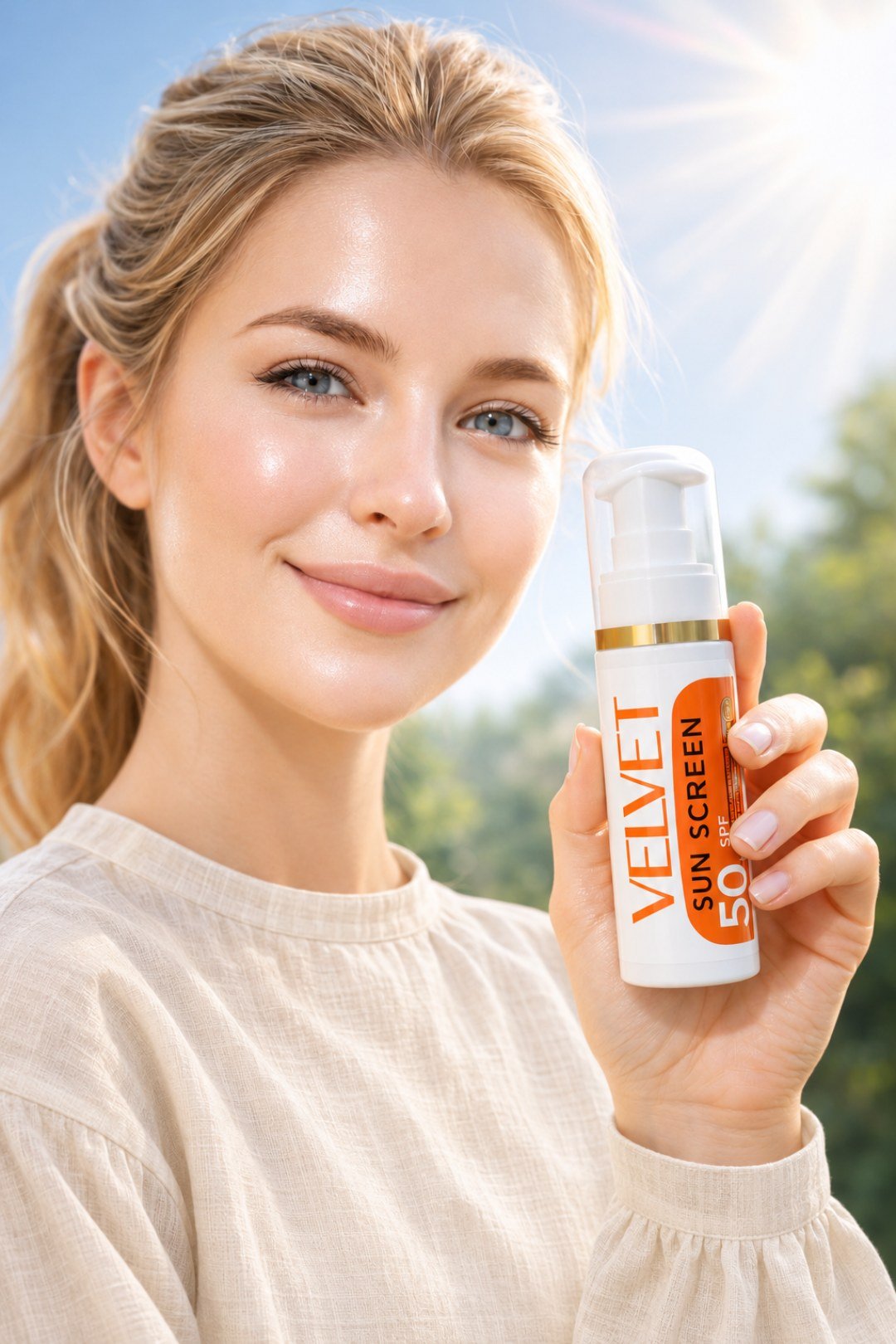
VELVET SPF 50+ is a light sunscreen serum-gel with UVA and UVB protection for daily use on the face. Hyaluronic acid and panthenol (vitamin B5) help keep the skin hydrated, aloe vera and rose water soothe it, and licorice extract helps even the tone. It dries fast, leaves no white trace and works under make-up.

Meet the ingredients
ProfessionalA scientific summary for pharmacists and physicians; references are published and verified on PubMed.
Ultraviolet radiation and the skin
UVB (280–315 nm) drives erythema and direct DNA photoproducts; UVA (315–400 nm) penetrates to the dermis, generates reactive oxygen species, degrades collagen and induces pigmentation. Chronic exposure underlies photoaging, actinic damage and keratinocyte and melanocytic cancers.
Evidence for daily sunscreen
In the Nambour community trial, daily broad-spectrum sunscreen reduced squamous-cell carcinoma (Green 1999) and, at 10-year follow-up, invasive melanoma (Green 2011). In the same population daily use prevented measurable photoaging over 4.5 years (Hughes 2013).
Real-world protection
SPF is measured at 2 mg/cm²; consumers typically apply 0.5–1 mg/cm², so delivered protection is much lower than labelled (Petersen 2014). SPF and UVA protection are properties of the finished formulation, depending on filter solubility, photostability and film uniformity (Hanay 2021). EU labelling requires UVA protection of at least one third of the SPF.
Sunscreen in dermatological treatment
Retinoid labels and trials advise minimising sun exposure during treatment (Sitohang 2022). In post-inflammatory hyperpigmentation, broad-spectrum photoprotection is part of first-line management (Tan 2022). After superficial chemical peels, moisturisers support barrier recovery and sunscreen is resumed when the skin tolerates leave-on products (Santos-Caetano 2020).
Counselling
Advise a generous layer every morning, reapplication every 2 hours outdoors and after water or sweat, shade and clothing at midday, no sunscreen as a reason to prolong exposure, and keeping infants under 6 months out of direct sun. Texture and comfort drive adherence.
References
- 1Green A, Williams G, Neale R, et al. Daily sunscreen application and betacarotene supplementation in prevention of basal-cell and squamous-cell carcinomas of the skin: a randomised controlled trial. Lancet. 1999;354(9180):723–729. PMID 10475183 DOI
- 2Green AC, Williams GM, Logan V, Strutton GM. Reduced melanoma after regular sunscreen use: randomized trial follow-up. J Clin Oncol. 2011;29(3):257–263. PMID 21135266 DOI
- 3Hughes MCB, Williams GM, Baker P, Green AC. Sunscreen and prevention of skin aging: a randomized trial. Ann Intern Med. 2013;158(11):781–790. PMID 23732711 DOI
- 4Petersen B, Wulf HC. Application of sunscreen – theory and reality. Photodermatol Photoimmunol Photomed. 2014;30(2-3):96–101. PMID 24313722 DOI
- 5Hanay C, Osterwalder U. Challenges in formulating sunscreen products. Curr Probl Dermatol. 2021;55:93–111. PMID 34698033 DOI
- 6Sitohang IBS, Makes WI, Sandora N, Suryanegara J. Topical tretinoin for treating photoaging: a systematic review of randomized controlled trials. Int J Womens Dermatol. 2022;8(1):e003. PMID 35620028 DOI
- 7Tan MG, Kim WB, Jo CE, et al. Topical treatment for postinflammatory hyperpigmentation: a systematic review. J Dermatolog Treat. 2022;33(5):2518–2526. PMID 34525885 DOI
- 8Santos-Caetano JP, Vila R, Gfeller CF, Cargill M, Mahalingam H. Cosmetic use of three topical moisturizers following glycolic acid facial peels. J Cosmet Dermatol. 2020;19(3):660–670. PMID 31322804 DOI
Found it useful? Share it with someone who cares
This article is general information and is not a substitute for advice from a doctor or pharmacist.