Hair & scalp4 min read · 9 references
Scalp psoriasis: calming thick scales with patience and the right care
Why scalp psoriasis is more than dandruff, what sets off flares, and how gentle scale care works alongside your doctor's treatment.
Did you know?
Scalp psoriasis is an immune-mediated condition — it is not contagious and is not caused by poor hygiene.
The scalp is one of the most common sites of psoriasis, and plaques often extend beyond the hairline.
Salicylic acid is a keratolytic that helps soften and loosen thick scale so other treatments can reach the skin.
Joint pain or stiffness alongside psoriasis should be checked by a doctor, as it may signal psoriatic arthritis.
Scalp psoriasis can be frustrating: thick, silvery scales that cling to the hair, an itch that will not settle, and flakes that show on dark clothes. The good news is that it is common, well understood, and manageable with a steady routine and the right medical support.
What is scalp psoriasis?
Psoriasis is a long-term, immune-mediated skin condition. The immune system sends signals that make skin cells grow much faster than usual, so they pile up into raised, red patches covered with thick scale. The scalp is one of the places psoriasis appears most often — up to 8 in 10 people with psoriasis have it there. Patches often creep past the hairline onto the forehead, behind the ears or onto the back of the neck.
Psoriasis is not contagious. Nobody can catch it from touching, sharing a towel or using the same hairbrush, and it is not caused by poor hygiene.
Psoriasis, dandruff or seborrheic dermatitis?
These three are easy to confuse, and they sometimes overlap.
- Dandruff: small, loose, white or greyish flakes with little or no redness.
- Seborrheic dermatitis: softer, greasy, yellowish scale on pink skin, often also around the eyebrows, the sides of the nose and the ears.
- Scalp psoriasis: clearly outlined, thicker patches with dry, silvery-white scale that can be firmly stuck; psoriasis may also appear on the elbows, knees or nails.
If it is not clear which one is present, a pharmacist or doctor can help tell them apart.
Common triggers
Psoriasis tends to come and go in flares. Things that can set off a flare include:
- Stress and poor sleep
- Infections, such as a sore throat
- Scratching, picking or injuring the skin
- Cold, dry weather
- Smoking and heavy drinking
- Some medicines — it helps to tell the doctor about everything being taken
Keeping a simple diary can help reveal a personal pattern.
Myths worth leaving behind
MythScalp psoriasis is just bad dandruff from not washing enough.
FactIt is an immune-mediated condition, not a hygiene problem. Regular washing helps manage scale, but it neither causes nor cures psoriasis.
MythPicking off the scales clears them faster.
FactPulling and scratching can injure the skin, worsen the itch, cause bleeding and even trigger new patches. Softening the scale gently works better.
MythPsoriasis can spread from person to person.
FactIt is not contagious in any way.
What helps
Care usually works in layers.
- Gentle scale removal. Softening scale before lifting it lets treatments reach the skin. Massage the scalp with the fingertips, never the nails, and use a soft comb.
- Keratolytics. Ingredients such as salicylic acid help loosen and lift thick scale.
- Medicated shampoos. Coal tar and other medicated shampoos are used as supportive care to ease scaling and itch. Leaving the lather on the scalp for the time stated on the pack before rinsing gives it a chance to work.
- Prescription treatments. For many people, the main treatment is a prescription product from the doctor, such as a corticosteroid or a vitamin D–based solution, foam or gel made for the scalp. For more severe or stubborn psoriasis, doctors may recommend tablets, injections or light therapy.
- Kind habits. Pat the hair dry instead of rubbing, use a cool setting on the hair dryer, and avoid tight hairstyles.
Most people need ongoing care rather than a one-time fix, so patience pays off.
When to see a doctor
It is time to book an appointment if any of these appear:
- Joint pain, stiffness or swelling, especially in the fingers, toes or lower back — this may be psoriatic arthritis
- Patches spreading to many areas of the body
- Noticeable hair loss or thinning in the affected areas
- Signs of infection: increasing pain, warmth, oozing, yellow crusts or fever
- No improvement after several weeks of regular care, or a big effect on sleep, mood or confidence
Riviera Pharma
How Riviera can help
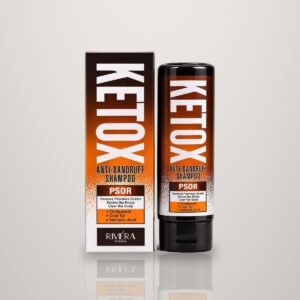
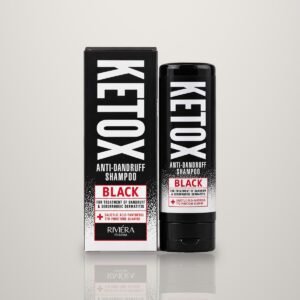
Two Riviera shampoos can support a scaly-scalp routine. KETOX Psor is a medicated shampoo made for thick, psoriasis-prone and sebopsoriasis scale: pine tar and salicylic acid help loosen and lift scale and calm itch, while climbazole and piroctone olamine tackle the scalp yeast that worsens mixed scaling, with niacinamide, gluconolactone, panthenol, allantoin and aloe to support the scalp barrier. KETOX Black is an anti-dandruff shampoo with climbazole, piroctone olamine, salicylic acid, zinc pyrithione, panthenol and tea tree oil. Both help as part of regular cleansing alongside any treatment the doctor has prescribed; none replaces prescription treatment for psoriasis. Tar can increase sensitivity to sunlight, so avoid long sun exposure after use. Ask your pharmacist which shampoo suits your scalp and how to fit it into your routine.
Meet the ingredients
ProfessionalA scientific summary for pharmacists and physicians; references are published and verified on PubMed.
Definition
Scalp psoriasis is the localisation of chronic plaque psoriasis to the scalp. It presents as sharply demarcated, erythematous plaques with adherent silvery-white scale that frequently extend beyond the hairline to the forehead, retroauricular folds and nape. Pruritus is common. Because of its visibility, the difficulty of applying topicals through hair and its effect on quality of life, the scalp is regarded as a special, difficult-to-treat site (Chan 2009; Mosca 2021).
Epidemiology
Psoriasis prevalence in adults varies widely by region, from roughly 0.14% in East Asia to 1.99% in Australasia, and is higher in high-income regions (Parisi 2020). The scalp is involved in up to about 80% of patients with psoriasis, making it one of the most frequently affected sites (Mosca 2021; Blakely 2016). Psoriatic arthritis develops in a substantial proportion of patients, and cardiometabolic disease, depression and reduced quality of life are recognised comorbidities (Griffiths 2021; Armstrong 2020).
Pathophysiology
Psoriasis is a chronic immune-mediated disease arising from genetic susceptibility (notably HLA-C*06:02) interacting with environmental triggers. Activated dendritic cells release IL-23 and TNF, driving Th17 differentiation and production of IL-17A, IL-17F and IL-22. These cytokines induce keratinocyte hyperproliferation, abnormal differentiation with parakeratosis, neutrophil recruitment and a self-amplifying inflammatory loop (Griffiths 2021; Armstrong 2020). Recognised triggers include streptococcal infection, psychological stress, smoking, alcohol, obesity, certain drugs and skin trauma (Koebner phenomenon), which is why scratching and forceful scale removal can perpetuate scalp disease (Griffiths 2021).
Diagnosis and differential
Diagnosis is clinical. Examination should include the elbows, knees, nails, umbilicus and natal cleft, together with screening questions for inflammatory joint symptoms. On trichoscopy, regularly distributed red dots, globules and twisted red loops favour psoriasis, whereas arborising vessels with yellowish scale favour seborrheic dermatitis (Wang 2017). The main differential is seborrheic dermatitis, which has greasy, yellowish, less well-defined scale that rarely extends far beyond the hairline; overlapping cases are often termed sebopsoriasis. Others include tinea capitis (particularly in children; broken hairs, lymphadenopathy, confirm with microscopy and culture), pityriasis amiantacea, lichen simplex chronicus, atopic and contact dermatitis, and discoid lupus erythematosus. Biopsy is reserved for diagnostic doubt or suspected scarring alopecia (Wang 2017; Mosca 2021).
Management and evidence
Severity assessment should consider extent, symptoms and impact on quality of life (Mosca 2021).
- Keratolytics: salicylic acid reduces corneocyte cohesion, softening and removing scale and enhancing penetration of other topical agents; it is commonly used before or with corticosteroids. It inactivates calcipotriol, so the two should not be applied together (Lebwohl 1999).
- Topical corticosteroids: high-potency agents are the mainstay of initial therapy, available in shampoo, foam, solution and spray vehicles suited to hair-bearing skin; short-contact shampoo formulations can improve adherence (Elmets 2021; Mosca 2021).
- Vitamin D analogues: calcipotriol (calcipotriene) can be used alone or, more effectively, as a fixed combination with betamethasone dipropionate, which is supported by strong evidence and is well tolerated on the scalp (Elmets 2021; Wang 2017).
- Coal tar: has antiproliferative, anti-inflammatory and antipruritic effects; tar shampoos are widely used as adjunctive care, although supporting evidence comes mainly from older, smaller studies and cosmetic drawbacks such as odour and staining limit use (Elmets 2021; Wang 2017).
- Systemic therapy: moderate-to-severe or refractory scalp disease may justify phototherapy or systemic treatment even when body surface area is limited (Chan 2009). Biologics targeting TNF, IL-17 and IL-23 achieve high rates of scalp clearance in trials and subanalyses; methotrexate and apremilast are further options (Mosca 2021).
- Adherence: matching the vehicle to patient preference and keeping regimens simple are central to success (Blakely 2016).
Antifungal anti-dandruff shampoos may help a coexisting seborrheic component in sebopsoriasis, but they are not a treatment for psoriasis itself.
Safety
Topical corticosteroids may cause atrophy, telangiectasia, folliculitis and tachyphylaxis, and extensive prolonged use of very potent agents carries a risk of hypothalamic–pituitary–adrenal axis suppression (Elmets 2021). Vitamin D analogues can cause irritation, and excessive use may raise serum calcium (Elmets 2021). Salicylic acid can irritate, and systemic salicylism has been reported with extensive application, especially in children and in renal or hepatic impairment (Lebwohl 1999). Coal tar may cause folliculitis, irritation, photosensitivity and staining (Wang 2017). Refer patients with joint symptoms, widespread plaques, marked hair loss, signs of secondary infection, diagnostic uncertainty or inadequate response to topical care (Mosca 2021; Griffiths 2021).
References
- 1Mosca M, Hong J, Hadeler E, Brownstone N, Bhutani T, Liao W. Scalp psoriasis: a literature review of effective therapies and updated recommendations for practical management. Dermatol Ther (Heidelb). 2021;11(3):769-97. doi:10.1007/s13555-021-00521-z PMID 33893995 DOI
- 2Wang TS, Tsai TF. Managing scalp psoriasis: an evidence-based review. Am J Clin Dermatol. 2017;18(1):17-43. doi:10.1007/s40257-016-0222-4 PMID 27650520 DOI
- 3Blakely K, Gooderham M. Management of scalp psoriasis: current perspectives. Psoriasis (Auckl). 2016;6:33-40. doi:10.2147/PTT.S85330 PMID 29387592 DOI
- 4Chan CS, Van Voorhees AS, Lebwohl MG, Korman NJ, Young M, Bebo BF Jr, et al. Treatment of severe scalp psoriasis: from the Medical Board of the National Psoriasis Foundation. J Am Acad Dermatol. 2009;60(6):962-71. doi:10.1016/j.jaad.2008.11.890 PMID 19375191 DOI
- 5Elmets CA, Korman NJ, Prater EF, Wong EB, Rupani RN, Kivelevitch D, et al. Joint AAD-NPF guidelines of care for the management and treatment of psoriasis with topical therapy and alternative medicine modalities for psoriasis severity measures. J Am Acad Dermatol. 2021;84(2):432-70. doi:10.1016/j.jaad.2020.07.087 PMID 32738429 DOI
- 6Griffiths CEM, Armstrong AW, Gudjonsson JE, Barker JNWN. Psoriasis. Lancet. 2021;397(10281):1301-15. doi:10.1016/S0140-6736(20)32549-6 PMID 33812489 DOI
- 7Armstrong AW, Read C. Pathophysiology, clinical presentation, and treatment of psoriasis: a review. JAMA. 2020;323(19):1945-60. doi:10.1001/jama.2020.4006 PMID 32427307 DOI
- 8Parisi R, Iskandar IYK, Kontopantelis E, Augustin M, Griffiths CEM, Ashcroft DM. National, regional, and worldwide epidemiology of psoriasis: systematic analysis and modelling study. BMJ. 2020;369:m1590. doi:10.1136/bmj.m1590 PMID 32467098 DOI
- 9Lebwohl M. The role of salicylic acid in the treatment of psoriasis. Int J Dermatol. 1999;38(1):16-24. doi:10.1046/j.1365-4362.1999.00500.x PMID 10065604 DOI
Found it useful? Share it with someone who cares
This article is general information and is not a substitute for advice from a doctor or pharmacist.